If you are comparing logo kit vs brand guidelines, you are probably trying to answer a very practical question: what do I actually need to launch, look professional, and stay consistent without overpaying for assets I will not use yet?
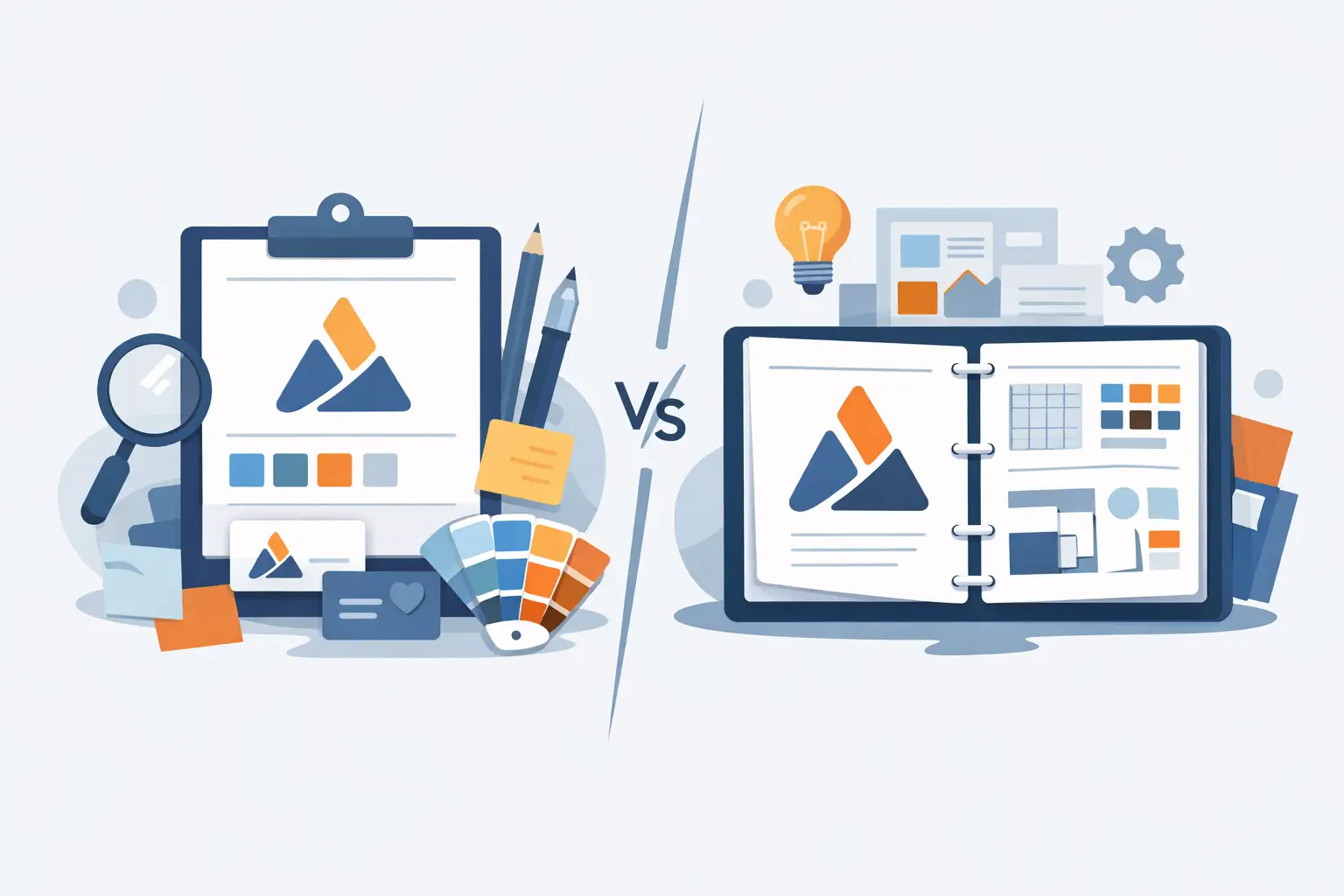
That question matters because these two deliverables solve different problems. A logo kit gives you the core files you need to start using your brand in the real world. Brand guidelines tell you how to use those assets consistently across cards, flyers, social media, signage, websites, and future marketing. One is about immediate execution. The other is about control as your brand starts showing up in more places.
Logo kit vs brand guidelines: the core difference
A logo kit is usually a focused package of ready-to-use logo assets. Think logo variations, file formats, and the essential versions needed for print and digital use. For a small business launch, that can be exactly the right starting point because it gets you moving fast.
Brand guidelines are broader. They document the rules behind the visuals so your business looks consistent even when multiple people are creating materials. That often includes logo usage rules, color values, typography choices, spacing, sizing, image direction, and examples of correct and incorrect application.
A simple way to think about it is this: a logo kit gives you the tools, while brand guidelines give you the operating instructions.
Neither is automatically better. It depends on where your business is, how many brand touchpoints you manage, and whether consistency is currently a risk.
What a logo kit usually includes
For many small and mid-sized businesses, a logo kit is the most practical first step because it covers the essentials without slowing the project down. A strong logo kit typically includes your primary logo, alternate logo versions, icon or mark variations, and the production files needed to use them properly.
That means you should expect common formats for both print and digital use, such as vector files for scaling and web-ready files for online platforms. You may also receive light guidance on where each version works best, such as full-color, black, white, horizontal, or stacked layouts.
The value of a logo kit is speed and usability. You can hand it to a printer, upload it to your website, place it on a business card, or use it on a flyer without needing to start from scratch each time.
For a local service business, hospitality operator, contractor, agent, or startup founder, this is often enough to begin. If your current goal is to get branded materials into market quickly, a logo kit keeps the process lean and budget-smart.
What brand guidelines usually include
Brand guidelines go beyond handing over files. They define how your brand should behave visually so every future asset feels like it belongs to the same business.
A practical guideline document often covers logo clear space, minimum sizes, approved color codes, font selection, hierarchy rules, and examples of correct placement. It may also include rules for backgrounds, photo style, iconography, and tone of visual communication.
This becomes more valuable when your brand starts expanding. If you are producing regular flyers, onboarding staff, working with multiple vendors, or updating your website and social channels at the same time, inconsistency starts costing you credibility. One flyer looks polished, the next looks off-brand, and your business begins to feel fragmented.
Good guidelines reduce that drift. They speed up decision-making because the rules are already defined. They also make collaboration easier because everyone is working from the same playbook.
When a logo kit is enough
A logo kit is often enough when your brand is still in its build stage and your immediate need is execution, not documentation.
If you are launching a business, refreshing a dated logo, or creating a small set of core materials like cards, flyers, and social graphics, you may not need a full guideline document yet. In that phase, what matters most is having professional files, practical versions of the logo, and a clear design partner who can apply them consistently across your initial collateral.
This is especially true if one studio is handling the rollout. If the same team is designing your logo, business card, flyer, and supporting visuals, much of the consistency is managed inside the process. You do not always need a long PDF explaining rules that your design partner is already controlling.
That is one reason modular brand systems work well for growing businesses. You can start with the assets that create momentum, then formalize the rules as your brand footprint grows.
When brand guidelines become necessary
Brand guidelines become necessary when your business is no longer making isolated design decisions.
If multiple people are touching the brand, such as staff, printers, sign shops, web developers, social media managers, or outside marketers, you need more than logo files. You need instructions that prevent guesswork.
They are also worth prioritizing when your brand appears in many formats. A business with storefront signage, vehicle graphics, menus, brochures, promotional flyers, uniforms, and digital ads has too many touchpoints to rely on memory or informal direction.
Another trigger is growth. Once you are producing materials regularly, small inconsistencies compound. Font substitutions, incorrect colors, stretched logos, and mismatched layouts can make a capable business look disorganized. Guidelines help protect the investment you already made in your identity.
The trade-off: speed now or structure now
This is where the logo kit vs brand guidelines decision becomes less theoretical and more commercial.
If you invest first in a logo kit, you get speed, lower upfront complexity, and faster deployment. That is ideal when you need to launch, sell, or promote right away. The trade-off is that you may need to add brand rules later once the business scales.
If you invest first in full brand guidelines, you get stronger control from day one. That can save time later and support better consistency across teams. The trade-off is that it often requires more planning, more decisions upfront, and a larger initial budget.
For many businesses, the smartest move is not choosing one forever. It is choosing the right sequence.
A practical way to decide
Start by looking at your next 90 days, not just your long-term ambitions.
If your next quarter is focused on launching, printing cards, running promotions, getting a website live, or creating basic visibility, a logo kit is probably the right starting point. It gives you immediate production value and keeps the process moving.
If your next quarter involves handing your brand to several vendors, expanding locations, building recurring campaigns, or scaling internal marketing, brand guidelines will likely pay for themselves quickly.
Ask yourself three direct questions. Do I need assets or rules? Am I solving for launch speed or brand control? Will one person manage the brand, or will several people need direction?
Those answers usually make the decision clearer.
Why many businesses need both, just not all at once
The strongest brand systems are often built in stages. That is not a compromise. It is practical planning.
A logo kit gives you the usable core. Then, as the business grows, guidelines capture the decisions already working and turn them into a repeatable system. This staged approach is often better for small and mid-sized businesses because it matches spending to actual operational needs.
That is also how a process-led studio should work. You should not be pushed into a heavy deliverable before you are ready for it. You should get what you need now, with a clear path for what comes next.
At Brandcrafter, that kind of structured rollout fits the way growing businesses actually buy creative support. Start with the essentials, keep the workflow collaborative and time-boxed, then build out a more complete system when your brand has more channels to manage.
What to ask before you buy either one
Before approving a project, ask what files are included, which logo variations you will receive, whether print and web formats are both supplied, and how revisions are handled. If you are discussing brand guidelines, ask how detailed the document will be and whether it covers real usage examples instead of generic rules.
You should also ask who the deliverable is designed for. A founder using a logo on a card has different needs from a team managing signage, social graphics, and vendor handoffs. The best package is the one that fits your current operating reality, not the one with the longest feature list.
A polished brand is not built by collecting documents. It is built by getting the right assets, in the right order, with enough structure to keep your business looking credible as it grows. If you are choosing between a logo kit and brand guidelines, the best next step is the one that helps you use your brand confidently tomorrow, while making the next stage easier when you get there.