
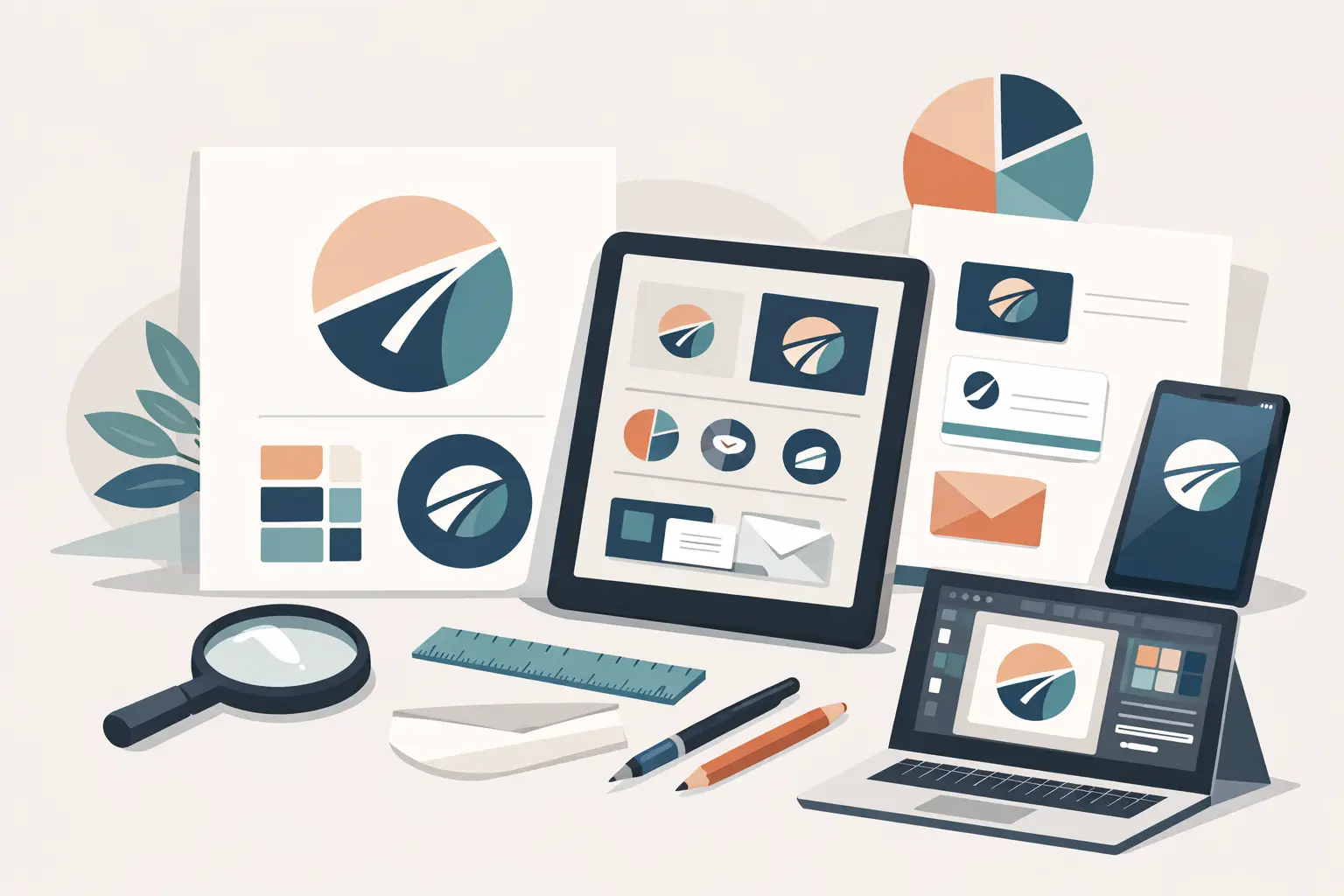
You approve a logo, the invoice is paid, and then the real question shows up – what does a logo kit include once the design is done? That matters more than most business owners expect. A logo is only useful if you can actually apply it across signs, social media, business cards, flyers, websites, uniforms, and day-to-day marketing without chasing files later.
A solid logo kit is not just a picture of your logo in an email. It is a working set of brand assets that helps you use your identity properly from day one. If you are launching a business or refreshing one, the difference between a basic logo handoff and a complete logo kit can save time, reduce printing mistakes, and keep your brand looking consistent wherever customers see it.
What does a logo kit include in practice?
In practical terms, a logo kit usually includes the logo in multiple versions, the right file formats for print and digital use, and basic guidance on how those assets should be used. The exact contents can vary depending on the studio, package level, and whether the project is part of a wider brand rollout. Some kits are very simple. Others are built to support business cards, flyers, signage, web graphics, and future marketing work.
For most small to mid-sized businesses, the best logo kit covers the essentials without overcomplicating things. You want enough flexibility to use your brand anywhere, but you do not need a large corporate brand manual if your immediate priority is getting visible and looking credible fast.
Primary logo files
The foundation of any logo kit is the primary logo. This is the main version of your logo, typically designed for standard use on websites, print materials, proposals, and storefront applications. It should be supplied in a range of file types rather than one flattened image.
You will usually want the primary logo in vector formats such as AI, EPS, or PDF. These are essential for professional printing because they can be scaled up without losing quality. If you ever need signage, vehicle graphics, uniforms, or large-format marketing materials, vector files matter.
You should also receive raster files such as PNG and JPG. PNG files are especially useful because they can have transparent backgrounds, which makes them easier to place on websites, presentations, or promotional graphics. JPG files are common for general use, although they are less flexible when transparency is needed.
Alternate logo versions
A good logo kit rarely stops at one version. Most brands need alternate layouts to fit different spaces. A horizontal logo may work well on a website header, while a stacked version may be better for social media, packaging, or vertical ad spaces.
This is one of the most useful parts of a logo kit because real marketing does not happen in one shape. If your only file is a wide logo, you may struggle to use it on profile images, flyers with limited space, or mobile-friendly placements. Alternate versions solve that problem while keeping the identity consistent.
In many cases, the kit also includes a logo mark or icon. That could be a symbol, monogram, initials, or simplified brand element that can be used where the full logo is too large or too detailed. This is especially helpful for social avatars, watermarks, stickers, and smaller branded materials.
Color variations
Your logo should not come in just one color treatment. A proper kit usually includes full-color, black, and white versions at a minimum. This gives you flexibility across light backgrounds, dark backgrounds, black-and-white printing, embroidered items, and low-cost promotional materials.
Some logo kits also include reversed versions for dark backgrounds and grayscale variations for newspaper ads or limited print runs. These may sound minor, but they prevent awkward situations where your logo disappears, loses contrast, or looks inconsistent from one piece of marketing to the next.
If your business relies on both digital and print marketing, color consistency matters. A well-prepared kit should make it clear which version is intended for each use case rather than leaving you to guess.
File formats your logo kit should include
If you are comparing providers, file formats are where quality becomes obvious. A cheap logo package often delivers only one or two file types, usually a small JPG or PNG. That may be enough for temporary social use, but it is not enough for a business that needs reliable branding.
A professional logo kit should generally include AI or EPS for editable vector source files, PDF for easy sharing and print workflows, PNG for transparent digital use, and JPG for simple everyday applications. In some cases, SVG may also be included for web use.
It depends on how you plan to use the logo. If you are only testing a side project, you may not need every format immediately. But if you are investing in business cards, flyers, signage, website design, and promotional materials, complete file coverage saves you from paying for file reconstruction later.
Editable vs. ready-to-use files
This is worth clarifying because many clients assume they are the same thing. Ready-to-use files are exported versions that can be placed into designs, uploaded online, or sent to a printer. Editable files are the master working files used to create or modify the logo.
Some studios include both as standard. Others keep source files restricted or include them only in higher-tier packages. Neither approach is automatically wrong, but the terms should be clear upfront. If you expect long-term flexibility or may work with other vendors later, ask specifically whether editable source files are part of the logo kit.
Brand details that often come with a logo kit
A stronger logo kit often includes more than logo files alone. It may also provide supporting brand details that help you apply the identity consistently across everyday materials.
That can include color codes such as CMYK, RGB, HEX, and Pantone references where relevant. These codes help printers, sign makers, and web designers reproduce your brand accurately. Without them, colors can drift from one platform to another.
Typography is another useful inclusion. If your logo kit specifies brand fonts or recommended font pairings, it becomes much easier to keep your flyers, business cards, presentations, and digital promotions aligned. This is where a logo starts becoming a usable brand system rather than a standalone graphic.
Some providers also include a basic usage guide. This does not need to be a 40-page manual. For many small businesses, a simple document covering logo spacing, minimum size, background control, and approved variations is enough to prevent the most common mistakes.
What a logo kit may not include
Not every logo kit includes broader brand assets, and this is where expectations need to stay realistic. A logo kit does not always include business card design, flyer design, social media templates, email signatures, website graphics, or photography. Those may sit in a wider package rather than the logo kit itself.
That said, for many growing businesses, the most practical investment is not just a logo in isolation. It is a coordinated set of brand essentials that can be rolled out quickly and consistently. If you know you will need cards, flyers, or web support right away, it often makes more sense to choose a structured package that connects those deliverables from the start.
This is where process matters. A studio with a clear framework, revision stages, and defined deliverables reduces ambiguity. You know what files you are getting, when feedback is due, and how the work will translate into real business use, not just concept approval.
How to judge whether a logo kit is actually complete
A complete logo kit should answer one simple question: can you use your brand confidently across print and digital channels without needing extra cleanup, resizing, or file requests? If the answer is no, the kit is probably too limited.
At minimum, look for multiple logo versions, color variations, vector files, digital files, and basic brand specifications. If your business relies on customer-facing marketing, it is also smart to think one step ahead. Will this kit support your next flyer, your next card reprint, your website header, and your social profile image? If not, the package may be cheaper now but more expensive later.
Brandcrafter approaches this through a practical delivery structure, so clients are not left guessing what comes next. That kind of process-led support matters when speed, clarity, and consistency are part of the decision.
The best logo kit is not the one with the most files. It is the one that gives your business exactly what it needs to show up professionally, stay consistent, and keep moving without friction.