You can usually tell when a logo project is going to drag before the first concept is even drawn.
It happens when the business owner says, “We’ll know it when we see it,” but there’s no clear audience, no real competitors named, and no decision-maker who can approve the direction. On the other hand, fast logo design is very real when the business has clarity, the designer has a defined process, and feedback is given on time.
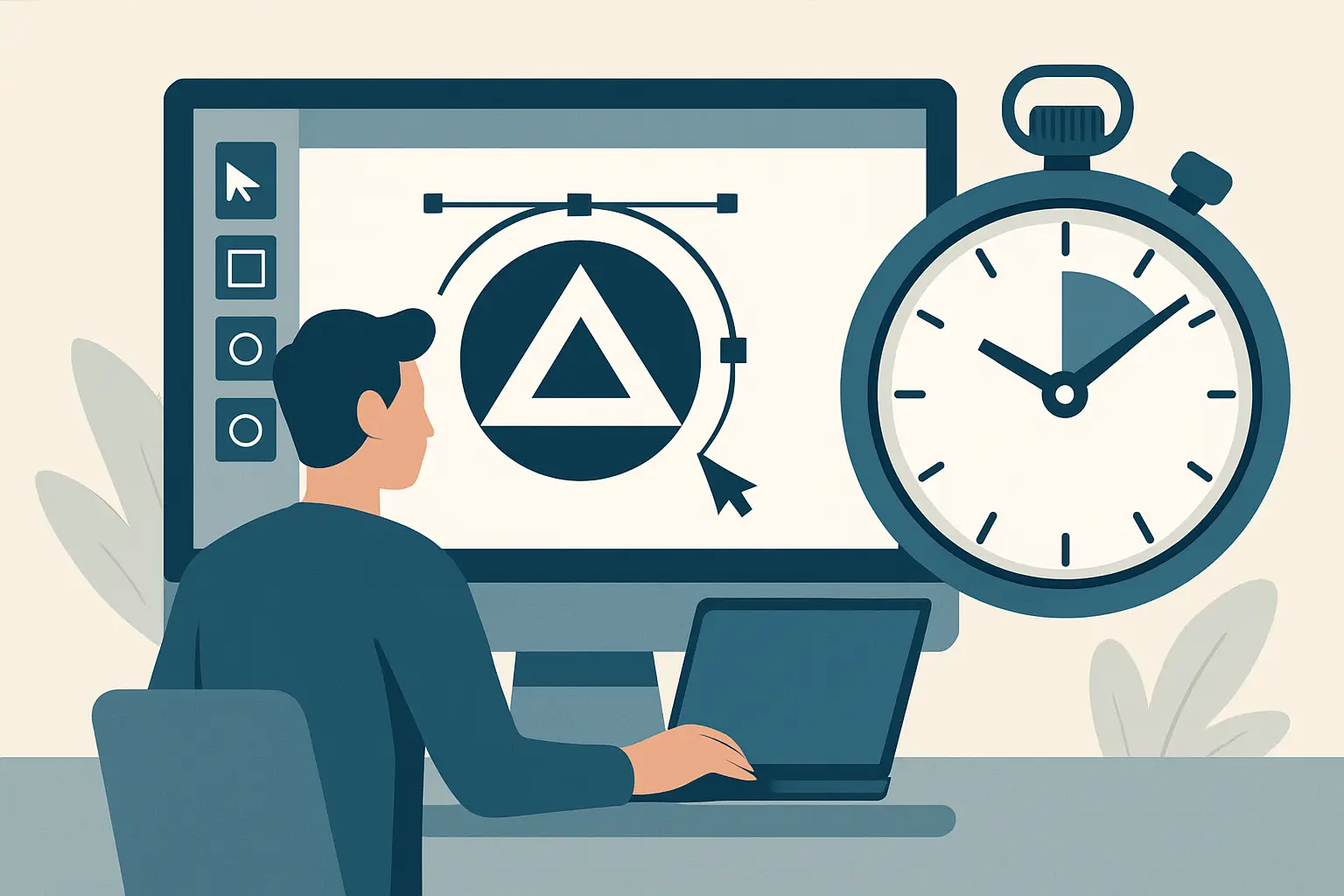
So, how long does logo design take in practice? Most professional logo projects land somewhere between a few days and a few weeks. The exact timeline depends less on “how hard design is” and more on inputs, approvals, and how many real-world uses the logo needs to handle.
How long does logo design take for most businesses?
For a small to mid-sized business that wants a professional logo that works on signage, social media, invoices, and print, a realistic range is 1 to 3 weeks from kickoff to final files.
A shorter timeline, like 2 to 5 business days, is possible when the scope is tightly defined and the client can make decisions quickly. A longer timeline, like 4 to 8 weeks, often shows up when there are multiple stakeholders, multiple brand directions being tested, or the project expands into broader identity work (colors, typography system, templates, and collateral).
The key point is this: the design time itself is only one slice. The rest is discovery, reviews, revisions, and production-ready exports.
The real timeline: what happens between “start” and “done”
A logo isn’t finished when it “looks good” on a white screen. It’s finished when it performs across the places your customers actually see it and when you have the file formats to use it without friction.
Here’s what a clean, professional timeline typically includes.
Step 1: Discovery and direction (1-3 days)
This is where the project either gets fast or gets expensive.
Discovery includes understanding what you sell, who you sell to, what you want to be known for, and what your logo must do in the real world. A restaurant might need a mark that reads clearly on a storefront sign and a delivery app icon. A property service might need something that stays legible on trucks, uniforms, and invoices.
If this stage is skipped or rushed, you’ll pay for it in revision rounds later. If it’s handled with structure, the rest of the project moves with confidence.
Step 2: Concept development (2-7 days)
This is the creative build stage – sketching, exploring directions, and turning the strongest options into workable logo concepts.
The big variable here is how many directions you’re trying to explore. If you want one clear, practical direction built for everyday business use, concept development is quicker. If you’re asking for “something modern, but also vintage, and maybe a little luxury, but not too expensive,” you’re really asking the designer to solve an identity problem that needs tighter inputs.
Step 3: Presentation and feedback (1-5 days)
The timeline often depends on you here.
If feedback comes back in 24-48 hours with clear notes, the project stays on schedule. If feedback takes a week, or gets routed through three people with conflicting opinions, the calendar stretches immediately.
Strong feedback is specific and tied to the goal. “Make the logo bigger” isn’t as useful as “It needs to read from 10 feet away on a sign,” or “Our customers are mostly families, this feels too aggressive.”
Step 4: Revisions and refinement (2-7 days)
Revisions are normal. Professional designers expect them. The question is whether revisions are refining a good direction or trying to change strategy midstream.
Refinement is things like adjusting spacing, simplifying shapes for small sizes, improving contrast, or tightening typography. Strategy changes are things like picking a completely different style, changing the company name, or deciding you now want a mascot instead of a wordmark. Strategy changes are possible, but they move the timeline because they reset earlier decisions.
Step 5: Final files and production prep (1-2 days)
This stage gets underestimated by people who haven’t dealt with printers, sign shops, and web uploads.
A finished logo package typically includes vector files for scaling, high-resolution print-ready files, and web-friendly versions. It should also include variations such as full color, one-color, and reversed options so your logo works on dark backgrounds, uniforms, or simple black-and-white documents.
If you only receive “a PNG,” you don’t actually have a complete logo deliverable. You have an image.
What makes logo design faster (without lowering quality)
Speed comes from a controlled process, not from cutting corners.
The fastest logo projects usually share a few traits. The business owner is clear on the offer and the customer. The decision-maker is in the loop from day one. Feedback is returned within a defined window, and it’s based on goals, not personal taste alone.
Scope matters too. A logo that needs to be a clean wordmark and a simple icon can move quickly. A logo that needs custom illustration, detailed linework, or multiple character concepts will take longer, especially if it must stay legible at small sizes.
What slows logo design down (and how to avoid it)
Most delays come from avoidable bottlenecks.
The first is unclear positioning. If you can’t articulate what makes your business different, the designer has to explore more directions to find something that fits. That exploration can be valuable, but it takes time.
The second is committee feedback. If three stakeholders can veto, but nobody can approve, you get churn. The fix is simple: assign one approver, gather input from others, and have one consolidated response.
The third is open-ended revisions. If you don’t define how many revision rounds are included, you risk stretching the project indefinitely. A structured revision policy protects both sides: you get focused improvement, and the designer can deliver on schedule.
The fourth is missing content. If the business name, tagline, or legal structure keeps changing, you’ll keep redoing the typography and layout. Lock the words first, then refine the visuals.
A practical timeline you can plan around
If you’re trying to schedule a launch, a website update, signage, or printed materials, you need a timeline that accounts for real life.
For most local service businesses and hospitality operators, a smart plan is to allow 2 to 3 weeks for logo design and final file delivery, then add time for whatever depends on it: printing, vehicle decals, menu updates, uniforms, or a website build.
If you’re on a tight deadline, the best move isn’t asking the designer to “rush.” It’s tightening the decisions. Know your primary audience, pick one decision-maker, and commit to giving feedback within 24-48 hours.
How long does logo design take when you need more than a logo?
A logo is often the first domino. Once it’s approved, everything else has to match it.
If you also need business cards, flyers, or a basic brand system (colors, typography, and layout rules), plan for additional time. The logo influences spacing, color usage, and overall brand tone. Building collateral before the logo is final almost always causes rework.
This is why modular “logo kits” can be a practical approach. You start with the core identity, then expand into the assets that actually touch customers. When the deliverables are staged, you can move fast without creating mismatched materials.
If you want a process built for speed, structured feedback, and real deliverables, that’s exactly how we run projects at Brandcrafter – personal collaboration, practical timelines, professional files you can use immediately.
How to keep your logo project on schedule
If you want the cleanest path to a finished logo, treat the project like a business decision, not an art contest.
Start by defining where the logo must work: storefront sign, Instagram avatar, vehicle decal, invoices, uniforms, or packaging. Then define what “good” means in that context – legible at small sizes, recognizable from a distance, or premium enough for your price point.
From there, keep the feedback cycle tight. Give the designer one clear, consolidated response per round. Approve a direction when it’s doing the job, even if you’re tempted to keep exploring. Exploration feels productive, but decisions are what create momentum.
A logo doesn’t need to impress other designers. It needs to make customers trust you quickly.
A helpful closing thought
If you’re asking “how long does logo design take,” you’re usually really asking, “How long until I can put this in front of customers with confidence?” The fastest way to get there is clarity plus commitment – clear goals, timely feedback, and a process that turns decisions into usable files.