
You usually do not realize the value of editable logo source files until something small turns expensive. A printer asks for a vector file. A sign shop needs to resize your logo for storefront vinyl. Your web designer wants a transparent version that will not blur on mobile. If all you have is a JPG pulled from an email thread, your brand is already working harder than it should.
For small and mid-sized businesses, this is not a technical side issue. It is a practical asset issue. Your logo is meant to move across business cards, flyers, uniforms, packaging, vehicles, websites, and social graphics without losing quality or consistency. That only happens when the original files are built properly and handed over in formats that support real-world use.
What editable logo source files actually are
Editable logo source files are the original working files used to create your logo. They are the files a designer can open, edit, resize, recolor, and export into other formats without rebuilding the artwork from scratch.
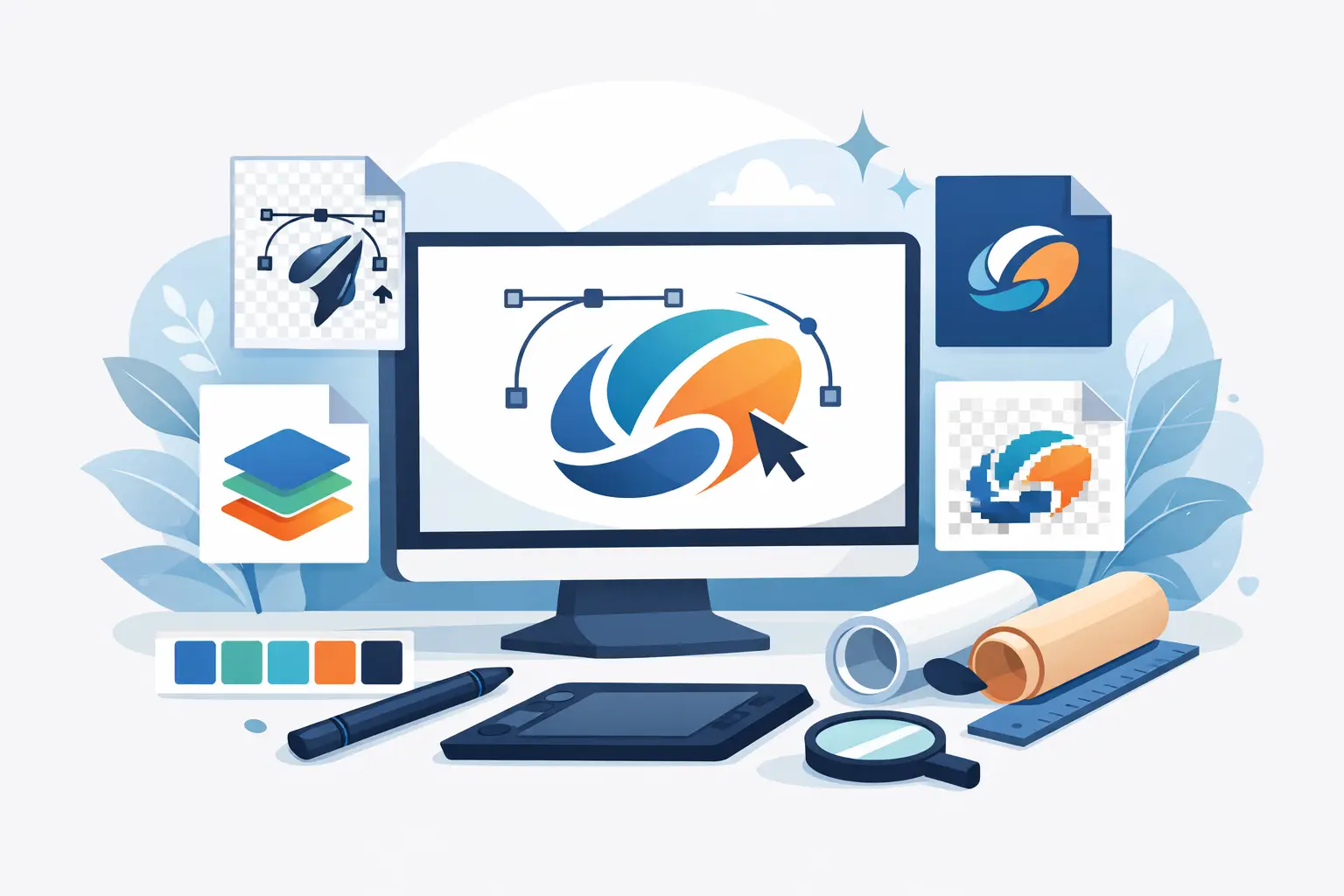
In most cases, these files are vector-based. That means the logo is built from shapes and paths rather than fixed pixels. Vector artwork scales cleanly from a tiny favicon to a large banner with no loss of sharpness. Common source file formats include AI, EPS, SVG, and sometimes PDF, depending on how the logo was created and how it will be used.
This is different from delivery files like JPG or PNG. Those are useful outputs, but they are usually end-use formats, not the master files. A PNG might work perfectly for a website header. A JPG might be fine for a quick social post. But neither is ideal if you need to change a font, update a tagline, prepare a one-color print version, or produce large-format signage.
Why editable logo source files matter to business owners
If you run a business, you need assets that save time, not create bottlenecks. Editable logo source files give you control over future production. They reduce rework, prevent avoidable quality issues, and make it easier to brief any printer, designer, marketer, or web developer you work with later.
That matters most when your brand starts showing up in more places. A startup may begin with a logo and business card. Then come flyers, vehicle graphics, staff uniforms, pull-up banners, email signatures, social ads, and landing pages. If your logo files are not editable, each new application becomes slower and more expensive because someone has to patch around file limitations.
There is also a consistency issue. When teams do not have access to proper source files, they start improvising. One vendor redraws the logo. Another grabs a low-resolution version from your website. A third changes the spacing because they cannot access the original artwork. The result is a brand that looks fragmented, even when the business itself is solid.
The difference between source files and usable exports
A good logo handoff includes more than one file type because different uses need different outputs. The source file is your master asset. Export files are the versions created from that master for daily use.
Think of it this way. The source file is the kitchen. The PNG, JPG, and PDF versions are the plated meals. You need both, but they serve different purposes.
For most businesses, the master file set should support editing, high-quality print, digital placement, transparent backgrounds, and simple sharing with vendors. If you only receive a single file, or if the designer cannot clearly explain what each format is for, that is usually a sign the handoff is incomplete.
Which file formats you should expect
Not every business needs the same logo package, but most should receive a practical mix of files that covers print and digital use.
AI is commonly the main editable file if the logo was built in Adobe Illustrator. EPS is widely accepted by printers and production vendors. SVG is useful for websites and digital applications because it stays sharp at different screen sizes. PDF can work as a clean, shareable vector file for some production needs.
Alongside those source formats, you should usually receive PNG files with transparent backgrounds, JPG files for simple placement, and color variations such as full color, black, and white. Depending on the logo system, it also helps to have horizontal, stacked, and icon-only versions.
What matters is not the number of files for the sake of it. What matters is whether the files match how your business actually operates.
When editable logo source files are most valuable
The need for source files becomes obvious during growth, but it starts earlier than many owners expect. If your business uses any outside supplier for print, signage, embroidery, packaging, or digital marketing, editable files are already relevant.
A property operator may need window decals, leasing boards, brochures, and social graphics. A hospitality business may need menus, uniforms, takeaway packaging, and event flyers. A local service provider may need vehicle wraps, door hangers, quote forms, and a website refresh. In each case, the logo has to work across different production methods and sizes.
That is where vector source files prove their value. They keep the brand crisp, adaptable, and easy to deploy without repeated redesign costs.
What can go wrong if you do not have them
The first problem is quality. Raster files like JPGs become blurry or pixelated when enlarged. That may be manageable on a temporary social post, but it looks unprofessional on signage or print.
The second problem is cost. If your logo needs to be recreated just to produce a clean print file, you are paying for a fix instead of progress. Sometimes that recreation is quick. Sometimes it becomes a full redraw because the original fonts, spacing, or artwork cannot be accurately recovered.
The third problem is speed. Vendors work faster when they receive proper files. If every job starts with troubleshooting, your timelines slip. That can affect launch dates, promotions, and seasonal campaigns.
There is also a legal and ownership angle. A business should be clear on what files are included in the project and what usage rights apply. If source files are excluded, say so upfront. If they are included, define the formats and handoff clearly. Ambiguity causes friction later.
How to ask for editable logo source files
You do not need to speak design jargon to ask the right questions. You just need a clear deliverables mindset.
Ask whether the logo package includes the original editable vector files. Ask which formats are included. Ask whether you will receive print-ready and web-ready versions. Ask for transparent background files and standard color variations. If your business uses signage, uniforms, or packaging, mention that early so the file set is built around those needs.
It also helps to ask how revisions are handled before final export. Once source files are packaged and approved, changes should be controlled and documented. That keeps the process efficient and avoids version confusion.
A structured studio will already have this built into its workflow. At Brandcrafter.co.nz, that kind of clarity fits the 3P Method – personal in collaboration, practical in file delivery, and professional in production readiness.
What a strong logo handoff should look like
A strong handoff is organized, clearly labeled, and easy for a non-designer to use. Files should be grouped in a way that makes sense, such as source files, print files, web files, and brand variations. Naming should be simple enough that your team can find the right version without guessing.
The handoff should also match the real demands of your business. If you only receive a logo mark but no lockups, no monochrome versions, and no transparent files, you are likely to run into friction as soon as the brand leaves the screen and enters day-to-day operations.
This is why a process-first design partner matters. Good branding is not only about creating a logo that looks polished on approval day. It is about delivering a file system that keeps working months later when you need your next flyer, new signage, updated cards, or a website refresh.
Editable logo source files are not a bonus item. They are part of the infrastructure behind a usable brand. If you want branding that stays fast, flexible, and professional as your business grows, make sure the files behind the logo are as well-built as the logo itself.
Your brand should be easy to use, not easy to break.