
A great business card can make a confident first impression. A flyer can put a timely offer in front of the right customer. But before either goes to print, one practical production choice affects your budget, timeline, and final result: offset versus digital printing.
Neither method is automatically better. The right choice depends on what you are printing, how many you need, how quickly you need them, and how precise the finished piece needs to be. For small businesses, that decision should support the job at hand rather than add cost or complexity.
Offset versus digital printing: the real difference
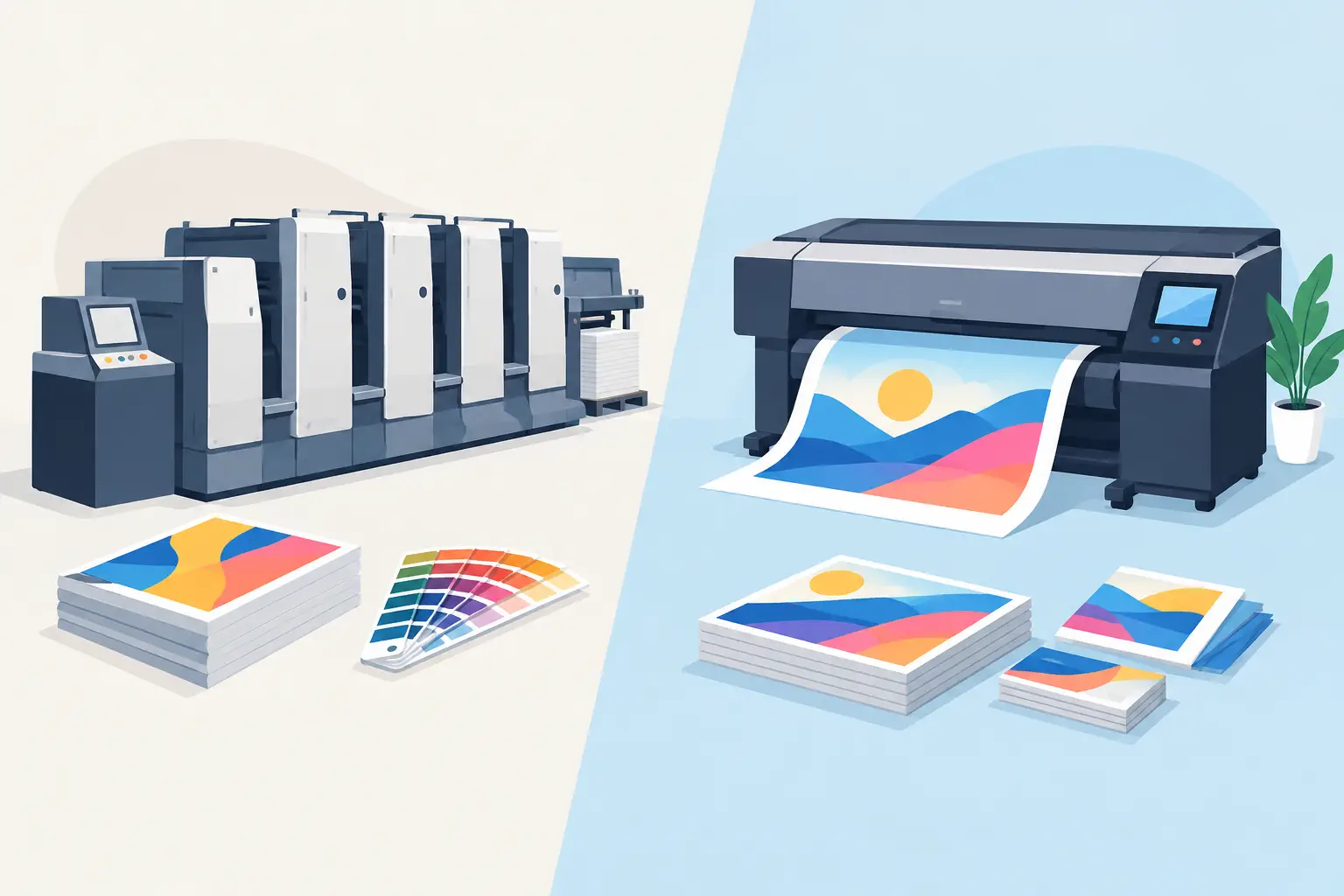
Digital printing sends your artwork directly from a digital file to a production press. There are no printing plates to make, so setup is quick and short runs are cost-effective. It is a strong option for business cards, menus, event flyers, direct mail pieces, and promotions where speed or version changes matter.
Offset printing transfers ink from custom metal plates onto a rubber blanket and then onto paper. The setup takes longer, but it delivers highly consistent color and becomes more economical as quantities increase. It is typically selected for larger print runs, brand collateral that must match an established color standard, and pieces requiring specialty inks or premium finishing.
The choice is not about choosing a basic option over a premium one. Both can look professional. It is about matching the production method to the volume, material, color expectations, and purpose of your marketing piece.
When digital printing makes more business sense
Digital print is built for fast-moving work. If your service pricing changes, your property availability shifts, or you are testing an offer before committing to a larger campaign, digital gives you room to move. You can produce a smaller quantity, review the response, then update the next version without losing money on unused stock.
It is usually the practical choice for runs in the tens or low hundreds, although the break-even point varies by paper, size, finish, and printer. Because it has low setup costs, the price per piece is often reasonable at lower volumes. You also avoid the upfront expense of plate production.
Digital is particularly useful when every printed piece needs different information. A real estate operator may personalize mailers by neighborhood. A hospitality business may need separate offers for weekday, weekend, and loyalty customers. Variable data printing can change names, QR codes, images, or messages from one piece to the next while keeping the core design consistent.
Digital printing is a strong fit when you need:
- Business cards for a new team member or a short staff run
- Flyers for a time-sensitive sale, event, or local campaign
- Multiple versions of a menu, service list, or promotional card
- A proof quantity before committing to a larger order
There are trade-offs. Digital presses can produce excellent color, but matching a specific brand color exactly may be more difficult than it is with offset. Results can also vary slightly across paper stocks and print providers. If your identity relies on a particular deep blue, vivid orange, or corporate spot color, discuss that requirement before production.
When offset printing earns its setup cost
Offset begins to make financial sense when you are producing a larger quantity of the same piece. While the setup costs are higher, the per-unit cost falls as the quantity rises. A business ordering several thousand brochures, presentation folders, postcards, or product sheets may get stronger value from offset than from digital.
Color control is another major reason to choose offset. Offset can use Pantone spot inks, which are pre-mixed inks designed to reproduce a specific color consistently. This is valuable for established brands that need their logo color to look the same across a trade show handout, sales brochure, letterhead, and future print runs.
Offset also gives more flexibility with certain paper stocks, ink coverage, and finishing methods. Large areas of solid color, fine gradients, metallic inks, and specialty projects can benefit from the process. For premium brochures or high-volume collateral that must feel as polished as your service, those details can justify the longer lead time.
The limitations are straightforward: offset takes more planning. Plate setup means it is less efficient for very small orders, last-minute changes can be costly, and variable data is not its natural strength. It works best when the design, copy, quantity, and offer are settled before files go to press.
A practical comparison
| Factor | Digital printing | Offset printing | | — | — | — | | Best quantity | Small to medium runs | Medium to large runs | | Setup time | Fast, with no plates | Longer, with plate setup | | Per-piece cost | Better at low quantities | Better at higher quantities | | Version changes | Easy and affordable | Less practical once plates are made | | Color matching | Very good, but press-dependent | Excellent control, including spot colors | | Personalization | Ideal for variable data | Generally not suited to variable data |
Paper, finish, and design still matter
Printing method is only one part of the result. A well-designed card on a thin, unsuitable stock will not feel as credible as a thoughtfully produced card on paper that supports the brand. The same applies to flyers: a strong offer needs a clear hierarchy, readable type, a purposeful call to action, and enough contrast to work at a glance.
Paper weight and coating influence both appearance and durability. Uncoated stock can feel natural, approachable, and easy to write on, making it useful for appointment cards and some professional services. Gloss or silk-coated stocks can make photography and color-rich artwork stand out, which often works well for food, hospitality, property, and retail promotions.
Finishing choices need a reason, not just a bigger budget. Matte lamination can protect frequently handled business cards and create a refined look. Spot UV can draw attention to a logo or offer. Rounded corners may suit a friendly, contemporary brand. If the finish competes with the message or slows production without adding value, it is not doing its job.
How to choose before you send a file
Start with your campaign objective. If you are launching a limited-time offer and need 150 flyers by the end of the week, digital is likely the sensible route. If you are replenishing 5,000 evergreen brochures used across multiple locations, offset may provide better unit economics and more dependable brand color.
Then ask whether the content is stable. Prices, phone numbers, team members, seasonal dates, and QR codes can all change. Print only as much as you can realistically use before the information becomes outdated. A lower unit price is not a saving if half the stock ends up in a storage room.
Finally, consider the customer experience. A premium consultant handing over a business card, a restaurant presenting a menu, and a trades business distributing a local-service flyer each have different needs. The format, stock, finish, and print method should reinforce how you want customers to see your business.
Prepare files for fewer production delays
A print-ready file prevents avoidable surprises, regardless of the production method. Before approving artwork, confirm these four details with your designer or printer:
- Final trim size and bleed, usually 0.125 inches beyond the cut edge
- High-resolution images, generally 300 DPI at their placed size
- CMYK color setup, unless specific spot colors are required
- Safe margins that keep text and logos away from trim lines
Also proof the content as carefully as the design. A typo in a headline is frustrating. An incorrect phone number, booking address, price, or legal detail can cost actual business. Check the proof at 100 percent size where possible, because type that looks readable on a large monitor can feel much smaller in print.
Build the print decision into your brand process
The best print outcome starts before production. When your logo, color palette, typography, image style, and key marketing formats are set up as a connected system, selecting a print method becomes faster and less risky. You are not reinventing a flyer every month or hoping a new card order matches the last one.
A structured design process also separates decisions that need creative input from decisions that need production logic. Your message, audience, and offer should shape the design. Quantity, timeline, color requirements, and finish should shape the print specification. Keeping those decisions connected protects both your budget and your brand consistency.
Choose digital when flexibility, speed, and smaller quantities matter most. Choose offset when scale, exact color control, and premium production value justify the setup. Then give the piece a clear job to do – earn the call, prompt the visit, secure the booking, or make the next conversation easier.